
FREQUENTLY ASKED QUESTIONS (FAQ)
Answers to frequently asked questions
Here you can find answers to common questions about job applications, working and living conditions, documents and wages.
If you cannot find what you are looking for, please feel free to get in touch!
Have you thought about moving to Finland for work?
We will give you an overview of everything you need to know before you go.
As Estonia, Latvia and Lithuania are members of the European Union, citizens of the Baltic States do not need a residence permit to work in Finland.
However, if you live in Finland for more than three months, you must register your right of residence. To register your right of residence, your means of subsistence in Finland must be secured.
Once the Finnish Immigration Service registers your right of residence, your personal data will automatically be entered into the population register and you will receive a Finnish personal identity code. You can also obtain the personal identity code from the Digital and Population Data Services Agency or the Tax Administration office.
If you are moving to Finland for a year or more, you must also register your place of residence with the nearest Digital and Population Data Services Agency office.

EU citizens do not need a work permit to work in Finland.
You have the right to work, run a business or study in Finland on the same terms as Finnish citizens. It is important to note that the tax system differs somewhat from that in Estonia, Latvia, and Lithuania.
Finland has a progressive income tax system, meaning that the tax rate depends on the annual income of a person. If you receive wages or any other income in Finland, you must apply for a tax card (verokortti) from the local Tax Administration office, which specifies your tax rate. This informs your employer how much tax to deduct from your wages.
As a general rule, a good command of Finnish is necessary to find work in Finland, as recruitment, administrative matters and day-to-day communication at work are conducted in Finnish.
The exception is when you find employment through a temporary work agency. When you start working through EstEmploy, you sign a contract with us and all communication is conducted in Estonian, Latvian, Lithuanian, Russian or English.
We will assist you in arranging all the documents required for working in Finland. During your stay abroad, you will also have a dedicated contact person with whom you can communicate in Estonian, Latvian, Lithuanian, English, Russian or Finnish.
Job offers in Finland can be found on online job portals, in newspapers, on social media and through personal networks.
It is generally safer to find work through a temporary work agency. In this case, you sign an employment contract with the agency, but work as a temporary agency worker for another company (user undertaking).
EstEmploy has been placing skilled workers in Finland for more than 10 years. Our customers include construction and industrial companies across Finland that are seeking experienced specialists. In the construction sector, we provide work opportunities for construction workers, painters, tilers, rebar and concrete workers, among others. The industrial sector is looking for welders, assembly fitters, metal element installers, CNC operators and concrete element manufacturers.
Where can skilled workers go to work abroad? Is it easy to find work abroad?
The two most common questions we receive at EstEmploy are: ‘How easy is it to find work abroad?’ and ‘Where can skilled workers go to work abroad?’
Below, we answer these questions based on our ten years of experience as a temporary work agency. During this time, we have worked with dozens of companies and hundreds of workers, earning the trust of both our customers and our workers.
What types of professionals do we place?
In the metal industry, our partners most commonly require certified welders and assembly fitters for different metals (depending on the work organisation of the company, they may sometimes look for a combined welder-fitter). There is also consistently high demand for CNC operators and metal structure installers.
Concrete industry companies are primarily seeking manufacturers of concrete elements. Just like elsewhere in the world, most buildings in Finland today are constructed from factory-produced concrete elements. To keep up with demand, factories have a rapidly increasing need for manufacturers of a variety of concrete elements, which are used to build walls, sandwich and hollow panels, posts, beams and other components that are later assembled into buildings on construction sites.
In the construction sector, EstEmploy finds work for professionals in a variety of roles, such as painters, tilers, construction workers, rebar and concrete workers for both indoor and outdoor projects.
Why are temporary agency workers used in construction and industry? The main reasons companies increasingly use temporary agency workers are flexibility and quality. Construction and industry are sectors where work is often seasonal, meaning the volume of work depends on the number of orders received. When orders increase, more workers are needed, and when they decrease, fewer workers are required. However, it is very difficult to predict future order volumes, as the market is constantly changing. This can lead to sudden increases or decreases in the volume of work.
Under such conditions, it is risky for a company to employ a large number of employees. Moreover, recruiting qualified employees at short notice can be difficult if the need arises. To respond quickly to such changes, companies in the construction and industrial sectors increasingly work with temporary work agencies, which provide flexibility and high-quality staff while handling the recruitment process on their behalf. In most cases, companies develop long-term co-operation and mutual trust with a single partner. That way, employers can be confident that the staff recruited through the agency are reliable and that the work will be completed to a high standard.
When there are no employees with the required qualifications available on the local labour market, recruiting temporary agency workers from abroad becomes the only viable solution. Workers from the Baltic States are motivated and hard-working, making them highly valued by Finnish employers.
Do you need to know Finnish to find work in Finland?
Knowledge of Finnish is always an advantage, as is knowledge of English, but in many workplaces you can manage with just Estonian, Latvian, Lithuanian or Russian.
This only applies if you are hired through a temporary work agency that handles the recruitment process and paperwork. When applying for a job directly with a Finnish company, a strong command of Finnish is essential, as all correspondence, interviews, contract negotiations etc will be conducted in Finnish.
When you go to work in Finland through us, you sign an employment contract with EstEmploy and all communication is conducted in Estonian, Latvian, Lithuanian, Russian or English. We also provide support with arranging the documents needed to work in Finland and assign you a personal contact for the entire duration of your stay, with whom you can communicate in Estonian, Latvian, Lithuanian, English, Russian or Finnish.
What kind of experience do you need to work abroad as a skilled worker?
Construction and manufacturing companies are looking for qualified skilled workers, ie people with professional skills and relevant work experience in the field. Naturally, every company provides an induction period for new employees to familiarise them with their processes, but in general, employees are expected to start working straight away.
For this reason, previous professional experience, training and certifications are very important when seeking a job. However, it is difficult to highlight uniform requirements – at EstEmploy, we assess each candidate’s profile and work experience individually.
Why is it easier to find work abroad through EstEmploy than on your own?
When a construction or manufacturing company finds a reliable partner in temporary agency work, the co-operation usually becomes long-term. The customer base of EstEmploy includes companies that we have been working with since our inception. Our partners trust our recruitment expertise and know they can rely on the employees we provide. When applying for jobs on your own, it is difficult to gain such immediate trust from employers.
Another important advantage of working through EstEmploy is that when work at one company ends (for example, when a construction site is completed), we can offer our employees positions with other partners. This means you no longer have to worry about the seasonal nature of work and have the opportunity to choose between different employers. Securing a new position quickly on your own, however, can be quite challenging.
We also handle a variety of day-to-day arrangements, such as organising accommodation and booking ferry tickets. EstEmploy employees stay in comfortable rental apartments, with each person having their own private room, fully covered by the employer. This saves you time, effort and money.
Who needs a Finnish Occupational Safety Card?
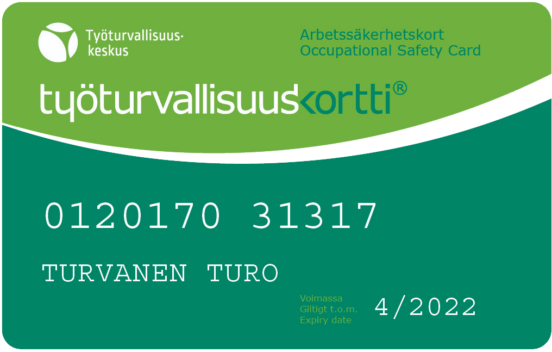
If you plan to work in the construction sector in Finland, you must have a Finnish Occupational Safety Card, also known as a green card, before starting work.
In Finnish, the card is called työturvallisuuskortti.
Photo: www.tyoturvallisuuskortti.fi
What is a Finnish Occupational Safety Card or green card?
As the name suggests, it is a green card issued personally in your name. The card certifies that you have completed occupational safety training in line with Finnish requirements and understand how to avoid hazardous situations and accidents at work.
This ensures that all employees have received the same occupational safety training. It is especially important when people from different countries are working together.
How do you obtain an Occupational Safety Card and what is an Occupational Safety Card test?
To obtain a green card, you must complete a one-day training course covering workplace hazards, occupational health and safety. The training concludes with a written knowledge test, which all participants must take.
In Estonia, Occupational Safety Card training is offered by several providers in Tallinn, Tartu and Narva. Some also offer the option to complete the training online, allowing you to study from a location that suits you.
Courses are held regularly in both Estonian and Russian.
Who pays for the green card?
As the Occupational Safety Card belongs to the employee and remains valid even after leaving a job, it is usually the employee who covers the cost of the training. Registered unemployed persons may be able to participate in the training using an Unemployment Insurance Fund training card.
The Finnish Occupational Safety Card is valid for five years. In addition to receiving a personalised card, everyone who completes the training is registered with the Finnish Centre for Occupational Safety (Työturvallisuuskeskus).
The card is recognised across the Nordic countries, including Finland, Sweden, Norway and Denmark.
A brief overview of the Finnish Occupational Safety Card
- To work on a construction site in Finland, you must hold a Finnish Occupational Safety Card, or green card – this applies whether you apply independently or through a temporary work agency.
- To obtain the card, you must complete a one-day Finnish Occupational Safety Card training course.
- In Estonia, the training can be completed in Tallinn, Tartu, Narva or online.
- The training is available in both Estonian and Russian.
- The Finnish Occupational Safety Card is valid for five years and remains valid when you change jobs.
The well-being of our employees is of utmost importance to us. Did you know that as an employee of EstEmploy OÜ, you receive free work clothes and safety equipment (such as helmets, goggles and ear protectors)? We also guarantee 100% financial support in the event of an accident at work – all our employees are covered by insurance.
Going to work abroad – through an agency or on your own?
Have you thought about working abroad but are not sure whether to try your luck independently or use the services of an agency?
Below, we outline both options to help you weigh the pros and cons and decide which approach suits you best.
What does going abroad to work on your own look like?
The following example is about going to work in Finland.
1. Finding suitable job offers
The first step is to find suitable job offers, which requires some research. Relevant information can be found:
- On Finnish job portals. For example, the InfoFinland website provides a comprehensive list of useful websites to get started.
- In Facebook groups dedicated to job offers in Finland. Try searching Facebook using keywords such as ‘job offers in Finland’, ‘work in Finland’ or ‘job offers abroad’.
- From friends and acquaintances who already have experience working abroad.
2. Employer background check
Once you have found an interesting job advertisement, take the time to check the employer’s background. Does the name of the company appear in any news related to fraud? Does the company have any outstanding debts or is it facing bankruptcy?
If anything seems even slightly suspicious, it is best to move on to the next opportunity – you do not want to waste your time, money or peace of mind on a potential scam.
3. Applying for the job and the importance of strong language skills
Next, take a close look at your CV. Does it include all the necessary and up-to-date information? Is your photo professional and taken within the past year? Is your CV written in correct Finnish?
Applying for jobs is often where many independent job seekers struggle. The realisation that you may need to travel to Finland for an interview and communicate fluently in Finnish can be daunting.
A basic understanding of the language is not enough. You must be able to understand the interviewer’s questions and speak confidently about yourself and your skills in complete, natural sentences. Good language skills are definitely your strongest asset.
4. Paperwork and finding accommodation
Dealing with all kinds of paperwork is a significant part of going to work abroad, and Finland is no exception.
Once you have been hired, you need to communicate with different authorities (eg the Tax Administration) to get all your documents in order. For your information: In Helsinki, you can usually get by with English, Estonian, Lithuanian, Latvian or Russian when dealing with most authorities, but outside the capital, everything is handled in Finnish.
You should also start looking for accommodation straight away. Even if you have not yet found a job and are still attending interviews, it is important to submit a housing application (asuntohakemus). In addition, you should have enough funds to cover the deposit and rent of the apartment.
5. Long-term plan
When taking on seasonal work, it is important to think from the outset about what will happen once the job ends. Will you return home? Or will you stay in Finland and look for another job opportunity?
If you are managing everything on your own, the cycle starts all over again: searching for a job, submitting applications, attending interviews and dealing with paperwork. All of this requires patience and a readiness to invest time and effort into the process. With a clear plan in place, you can maintain your focus and stay on course.
Who is suited to going abroad to work on their own?
As you may have gathered, going to Finland (or elsewhere) to work on your own is a rather complex and time-consuming process. People who know the local language and feel comfortable handling tasks that require accuracy and patience have a definite advantage.
Being willing to take initiative and maintaining a positive attitude in the face of setbacks will also be beneficial, as things may not always go as planned or expected.
Therefore, if you have the necessary language skills and personal characteristics, it is certainly worth giving it a try as it offers a highly valuable learning experience.
What does going abroad to work through an agency involve?
Temporary work agencies aim to simplify the process of working abroad by handling the paperwork and assuming some of the associated risks. This makes it easier for employers to hire staff and more convenient for specialists to take up work abroad. How it works with us:
- Add your CV to our database on our website.
- When a suitable job offer arises, we forward your CV to the employer and begin negotiations.
- If the employer decides to hire you, we sign an employment contract with you and handle all the necessary paperwork in Finland.
- We purchase your ferry tickets and provide you with new work clothes.
- You arrive at the agreed time and travel to Finland to start work.
To set ourselves apart from other temporary work agencies, we also cover your car fuel and apartment rent in Finland. In addition, you will be assigned a personal contact who is available 24/7 and can communicate with you in your native language (Estonian, Russian, Lithuanian or Latvian).
Note! If you plan to use a temporary work agency to work abroad, always check the background of the company to ensure it has no outstanding debts and is not involved in any suspicious activities.
Not all agencies provide the same benefits, so take your time to review the promises made by different companies and make your decision only after careful consideration. We cover this topic in more detail in this post.
Who is suited to working abroad through a temporary work agency?
Working through a temporary work agency is ideal for those who value convenience, time savings and want to minimise risks.
In summary, if you are skilled at your job and prefer security and hassle-free administration when going abroad to earn a fair wage, choosing a temporary work agency is the best option.
What is the work culture like in Finland?
The number of foreign workers in Finland has grown significantly in recent years, and they are generally treated with support and friendliness. Honesty, punctuality and equality are the core values of Finnish society and culture, and these are highly valued in the workplace as well. However, Finnish work culture has its own particular characteristics, which are good to know before starting work.
Justice and equality in working life
Equality is one of the core values of Finnish society. Everyone must be treated fairly and equally. In both Finnish society and families, there is no strict division of labour between men and women.
Finnish law prohibits any form of discrimination in the workplace. Employers are required to ensure equality and gender equality in the workplace, providing equal opportunities for both women and men to advance in their careers.
The Equality Act prohibits discrimination on the basis of age, national or ethnic origin, language, religion, belief, opinion, state of health, disability, sexual orientation or any other personal characteristics. Direct discrimination in working life occurs when employees from different backgrounds are paid differently for the same work. Indirect discrimination arises when an employee is placed in an unequal situation, for example, if perfect language skills are required during recruitment even though they are not strictly necessary for the job.

Punctuality and reliability
In Finland, schedules and agreed meeting times must be strictly followed. Being late is considered impolite, especially if it happens repeatedly. You must arrive at work at the agreed time – 8:00 means exactly 8:00, not 8:10. Being late is particularly inconsiderate if it directly affects colleagues or customer service. If you know you are going to be late, inform someone immediately.
Sticking to agreements is a fundamental part of Finnish work culture. Cancelling meetings or job interviews is viewed as a sign of unreliability. When decisions are made jointly, both employees and employers expect everyone to act in accordance with the agreed-upon arrangements.
Many workplaces offer flexible working hours, allowing employees to start between 7:00 and 9:00 and finish between 15:00 and 17:00. Even if the workplace has flexible working hours, employees must ensure they work the agreed number of hours each day.
Working hours are usually fixed and specified in the employment contract. The maximum working hours are set by law and typically average 8 hours per day or 40 hours per week. The standard full-time working hours are often set at 7.5 hours per day or 37.5 hours per week.
Under the Working Hours Act, overtime can only be performed with the employee’s consent and must always be compensated either financially or with time off. For shift work, the work schedule must be provided at least one week in advance.
Initiative and responsibility
Finnish employees are expected to be independent and take responsibility. New employees often have supervisors or mentors, but once established, managers generally do not closely monitor their work on a day-to-day basis. When planning work, employees are asked for their opinions, which are taken into account.
Duties are usually agreed upon in joint meetings, which are well-organised and efficient. he supervisor assigns duties to the employee and expects them to determine the details of the work at their own discretion. If an employee is unsure how to perform a task or is unable to do so, they are expected to seek guidance directly from colleagues or their supervisor.
Communication style
Finns tend to speak clearly and audibly, which is not considered rude. However, it is uncommon to raise your voice, shout or display strong emotions at work.
Direct and straightforward communication is typical in the workplace. After greetings, meetings usually get straight to the point without lengthy small talk.
In Finnish work culture, communication is generally informal and relaxed, and it is customary to use informal forms of address. In most workplaces, it is common to address superiors informally and light joking or banter is acceptable, helping to create a positive working atmosphere. Formal address is generally reserved for very formal situations.
Language skills
Although English is widely spoken in Finland, knowledge of Finnish – and preferably Swedish as well – is important. Language skills can be improved through courses, on-the-job practice and daily communication.
The influence of religion on working life
Many Finns identify as Christian, although most are not deeply religious. Nonetheless, Christian customs still influence Finnish culture. In the workplace, this is reflected through numerous public holidays. Christian holidays are observed as mandatory days off.
Food culture
Finns drink a lot of coffee and it is common to have coffee even during meetings. Lunch is eaten earlier than in many other countries, usually between 11:00 and 12:00 at workplaces and schools. Finns value healthy food. Rye bread and a variety of porridges are an important part of Finnish food culture.
Labour law, contracts and administration
Finnish working life is governed by numerous rules that both employees and employers must follow. Legislation and collective agreements set out, for example, minimum wages, working hours, vacation entitlements, sick pay and conditions for termination.
A resident of Estonia, Latvia, or Lithuania residents do not need a residence permit to live in Finland, but their right of residence must still be registered. We will handle both the registration of your right of residence and any other necessary formalities on your behalf.
How are temporary agency workers perceived in Finland?
In Finland, as in many other countries, temporary agency workers form a significant part of the working-age population. They are supported by temporary work agencies, which ensure that workers have continuous employment.
In Finland, temporary agency workers are highly valued and treated with the same respect as permanent employees. For some, temporary agency work is also a lifestyle choice, which is well suited to those who enjoy variety and different duties. At the same time, there is temporary agency work that can last for a year or more.
Estonian skilled and unskilled workers are increasingly valued, as Estonians and Finns share a similar cultural background. This familiarity has become particularly important recently, as Finland has begun importing workers from Romania, Bulgaria and other Eastern European countries.
How has temporary agency work developed in recent years?
Companies are increasingly relying on temporary agency workers, as it is difficult to predict whether business will develop positively or negatively in a rapidly changing economic environment. Temporary agency workers provide a flexible solution, allowing companies to secure staff exactly when the company needs them.
Companies have also started to reduce the number of permanent positions in order to optimise costs and, at the same time, respond more flexibly to changing circumstances by using temporary agency workers.
How does the recruitment process of EstEmploy work?
The easiest way to get started is by completing a short form on our website, which provides us with key information about your skills and background. Your CV will then be automatically added to our database and we will contact you as soon as a suitable job opportunity arises.
What questions are asked during interviews?
Once we have found a suitable candidate for a position, we invite them to a job interview. This meeting is important for both parties: we want to get to know who we are hiring and you will naturally want to learn more about your potential employer.
During the interview, we will go through your application and provide detailed information about the job itself, the employment contract and the wage conditions.
There is no need to be alarmed by questions about alcohol consumption, for example. We are very strict in this regard – work and the use of intoxicating or stimulating substances simply do not mix. We do not employ people with addiction problems.
What kind of employees are we looking for?
As a rule, qualified specialists – such as welders, builders and other skilled professionals – tend to find work the fastest.
Our team is made up of people who are:
- reliable,
- active,
- respectful and considerate towards themselves and others,
- dedicated to their work and mindful of the work culture.
If you recognise yourself in these descriptions, we would be happy to welcome you to our team!
How quickly can I find a job through EstEmploy?
Generally, the recruitment process takes around two weeks.
Can I get by if I do not speak Finnish?
It is always an advantage if the employee speaks Finnish or other languages, but in some positions or cases it is not required. For example, it may be enough if a friend or colleague speaks Finnish. You can also manage without language skills in independent or routine work.
However, some positions do require conversational Finnish skills. These include roles where regular communication with a Finnish employer or customer is necessary (for example, a waiter in a restaurant or a rebar worker on a construction site).
We recommend being honest about your language skills. This helps ensure a high-quality service for the customer and prevents any unexpected issues or misunderstandings for you. If we know your language skills are limited, we can provide better support to help you settle into your new job.
How are wages paid?
Employees are paid according to the number of hours worked. The hours worked are recorded on timesheets and once these have been verified with the signature of the responsible person, the wages are transferred.
Wages are always paid on the date agreed in the employment contract – without exception!
For how long is the work guaranteed?
The duration of work depends on the customer and the specific nature of the role. The shortest period for which EstEmploy hires out employees is one month.
Based on our experience, an average employment relationship with a single employer lasts around four to six months. However, there are always exceptions and some temporary agency workers have worked for the same company for as long as five to seven years.
Seasonal summer jobs usually last from the beginning of June until September.
In many cases, Finnish companies offer employees a direct contract after a longer period of reliable and high-quality work. We never stand in anyone’s way – in such cases, the employee is free to decide under which contract they wish to continue working.
What are the living and working conditions offered by EstEmploy?
Our employees are our greatest asset and we do everything possible to ensure they feel comfortable and supported. The well-being and high morale of our employees are very important to us. We always provide our employees with accommodation in apartments where everyone has their own private room. This allows them to relax and unwind in comfort after work.
The apartments are furnished and equipped with all necessary household appliances (washing machine etc).
We expect our employees to treat the accommodation with care, keep it clean and avoid damaging any property. When moving out, the apartment must be thoroughly cleaned.
Working conditions and culture in Finland differ considerably from what we are used to in in Estonia, Latvia, and Lithuania. Working conditions vary depending on the employer, but thanks to the strict labour regulations of Finland, the work culture is highly employee-oriented. Mandatory breaks are strictly observed and all required protective equipment is provided by the employer. If you encounter any problems or are assigned duties outside your qualifications, you must notify EstEmploy immediately – this is the only way we can assist you in resolving the situation in the best possible way.
How often can I go home?
As a rule, Finnish employers expect work periods to last around three weeks, followed by a week off.
Two-week cycles are also common, after which employees can return home for a week’s rest.
People working in the Helsinki area often take long weekends at home – for example, from Thursday evening to Sunday – because Helsinki is only two-hours away from Estonia and working near Helsinki does not require a personal car.
Work schedules can vary considerably, so the exact periods of work and rest should always be agreed directly with the employer. We can help you with the negotiations.
What is the holiday policy for employees?
Employees are entitled to holiday and holiday pay just like in any standard employment contract. Before taking holiday, you must submit a request for holiday to your employer (EstEmploy).
Once the request is approved, you will receive your earned holiday pay. Upon expiry of the employment contract, compensation is paid for unused holiday.
What are the terms and conditions of the contract concluded with EstEmploy?
The terms and conditions of the contract are essentially the same as those of a standard employment contract. You sign the employment contract with EstEmploy, which specifies that we may assign you to work for another company (our customer), ie you will be a temporary agency worker at a user undertaking. Your wages are also paid by EstEmploy.
We would like to highlight two points thar are important for employees:
1. ‘The employee works as a temporary agency worker at a user undertaking’ (for example, a Finnish construction company). With this we lay down and clarify that you are a temporary agency worker and will be working for our customer.
2. ‘The employment contract is entered into for a specified term or until the completion of the project or the end of the order by the user undertaking.’ This means that your contract is valid as long as the customer has work available. If the customer’s work runs out, it does not necessarily mean that your employment contract with us will end. We have a large customer base and are confident that we can always find a new placement for a good employee.